
Get ASO insights in your inbox.
Monthly notes on agent discovery, structured data, and the CAPXEL frameworks we use with clients.
SOCi's 2026 report confirms what we've been building for: AI visibility is the new battleground.
Yesterday, SOCi released the 2026 Local Visibility Index — their annual benchmark of how multi-location brands perform across digital channels. It's the most comprehensive study of its kind: 350,000+ locations, 2,751 brands, 120 performance metrics.
But one change made this year's report fundamentally different from every edition before it.
For the first time, SOCi added AI visibility as a core benchmark — measuring how well brands surface in ChatGPT, Google Gemini, and Perplexity alongside traditional search, social, and reputation metrics.
This isn't a footnote. It's not a "future trends" sidebar. AI visibility now sits at the same table as Google 3-pack presence and review sentiment. It's a core metric that determines which brands make the SOCi100.
We've been building for this moment.
What SOCi's 2026 Report Actually Found
The numbers are stark. SOCi's research reveals a massive gap between traditional search visibility and AI-driven discovery:
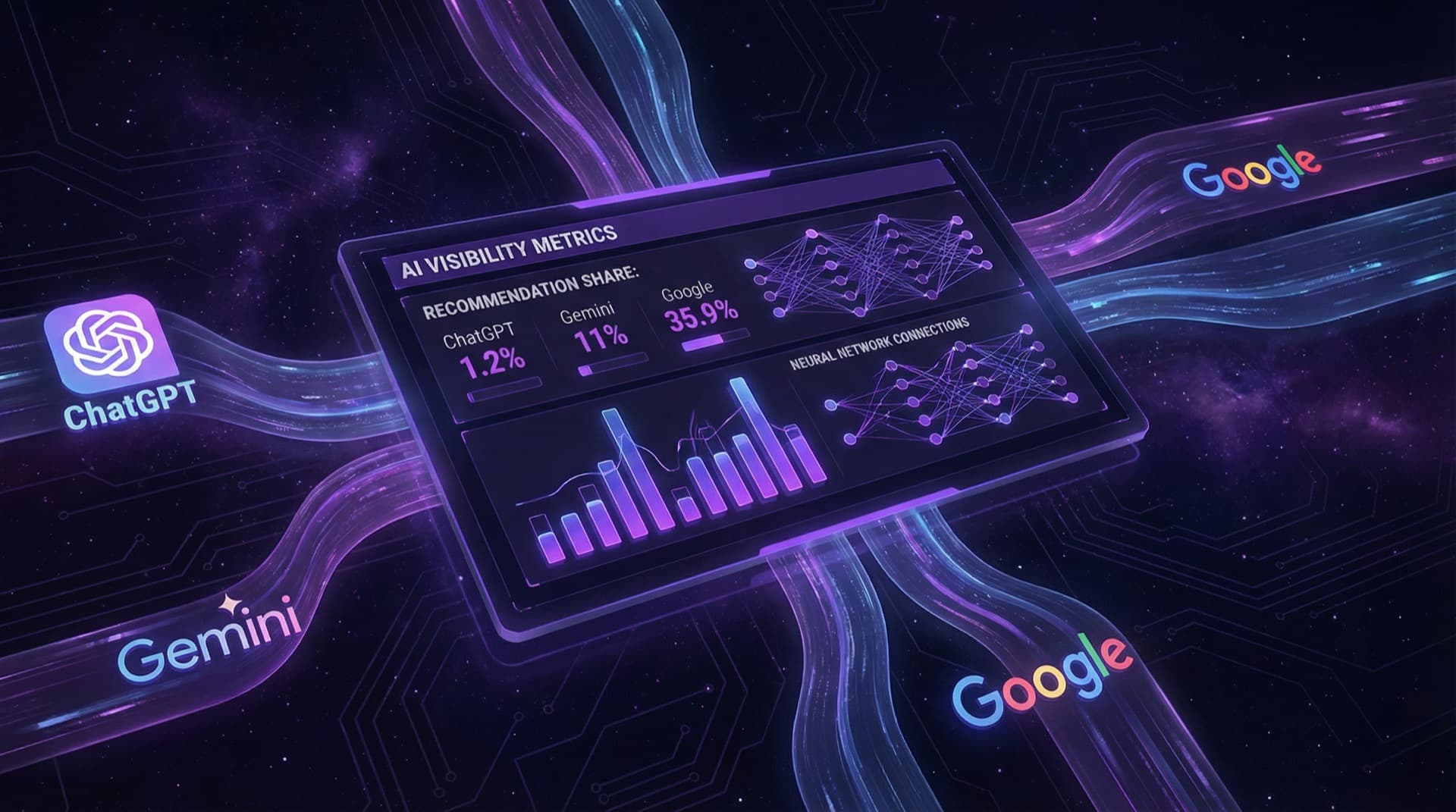
- Only 1.2% of locations were recommended by ChatGPT. Gemini recommended 11%. Perplexity, 7.4%.
- By comparison, brands appeared in Google's local 3-pack 35.9% of the time.
- AI visibility is 3x to 30x harder to achieve than ranking well in traditional local search.
Read that again. Brands that have spent years optimizing for Google — and succeeding — are almost invisible to the AI platforms that an increasing share of consumers actually use to make decisions.
Fewer than half of the top-performing brands in traditional local search also appear among the top brands in AI results. In retail, only 45% of the top 20 local search leaders overlapped with the top 20 AI-recommended brands. Being great at Google doesn't mean AI knows you exist.
The report also found that AI platforms favor businesses with above-average sentiment. Locations recommended by ChatGPT averaged 4.3 stars. On Gemini, 3.9. On Perplexity, 4.1. AI doesn't just surface brands — it filters them. Middling ratings that still rank in traditional search get excluded entirely from AI recommendations.
And perhaps most concerning: business profile accuracy on AI platforms was only about 68% on ChatGPT and Perplexity, compared to 100% on Gemini (which is grounded in Google Maps). AI assistants aren't just selective — they're often working with incomplete or incorrect information about the brands they do recommend.
As SOCi CMO Monica Ho put it: "Visibility today isn't about ranking. It's about being selected."
The Shift From "Ranking" to "Being Selected"
This distinction matters more than most marketers realize.
Traditional search returns a page of ten blue links. You optimize to climb the list. Higher position means more clicks. The game is incremental — move from position 8 to position 3, and traffic increases predictably.
AI doesn't work that way. When someone asks ChatGPT "What's the best Italian restaurant near me?" or asks Perplexity to compare CRM platforms, the AI doesn't return a ranked list of ten options. It returns one answer. Maybe two. Sometimes a short curated list.
You're either selected or you're invisible. There is no position 7. There is no second page.
This changes the economics of visibility entirely. In a world where AI often returns a single recommended brand, the gap between being chosen and being overlooked isn't a few percentage points of click-through rate. It's 100% versus zero.
SOCi's data confirms this is already happening at scale. And they've now built the measurement framework to track it. That's significant — because what gets measured gets managed.
What Most Brands Are Missing: The Infrastructure Layer
Here's what SOCi's report surfaces implicitly but doesn't say directly: most brands have no infrastructure for AI readability.
SOCi measures the outcome — whether your brand gets recommended. They benchmark, they score, they rank. That's valuable. But measurement alone doesn't move the number.
The question brands should be asking is: Why does the AI choose one brand over another?
It's not just reviews and ratings. It's not just data accuracy across directories. Those are necessary but insufficient. The deeper issue is that most websites are built for humans and search engine crawlers — not for AI agents.
AI assistants don't read your website the way Google does. They don't follow the same signals, parse the same structured data, or weight the same on-page elements. They need information in formats they can reliably extract, interpret, and trust.
Most brands are optimizing their Google Business Profiles and review responses (which matters) while completely ignoring the foundational question: Can an AI agent actually understand what your business does, where you operate, what makes you different, and why you should be recommended?
The answer, for the overwhelming majority of websites, is no.
This is the infrastructure gap. And it's the reason that AI visibility is 3x to 30x harder than traditional search visibility — not because the AI is biased, but because brands haven't built the layer that AI needs to read.
How Capxel and LLM-LD Close the Gap
At Capxel, we've been focused on this problem since before it had a name.
We coined the term Agentic Search Optimization (ASO) to describe the discipline of making brands discoverable, understandable, and selectable by AI agents. Not just optimizing for search engines — optimizing for the systems that are increasingly replacing them.
And we built the infrastructure to make it real.
LLM-LD is the open standard we authored specifically for this purpose. It's a structured data layer designed to make websites machine-readable for large language models — giving AI assistants the clean, reliable, contextual information they need to accurately understand and recommend a brand.
Think of it this way: Schema.org was built for search engines. LLM-LD was built for AI agents.
LLM-LD provides AI systems with structured context about your business — services, differentiators, geographic coverage, expertise, trust signals — in a format they can parse without ambiguity. It's the difference between an AI guessing what your brand does based on scattered web content and knowing with confidence.
Over 100 websites already use LLM-LD in production. We've been deploying AI-readable layers to client sites since before SOCi — or anyone else — was measuring AI visibility as a formal benchmark.
The results speak for themselves. Brands with LLM-LD implementation see measurable improvements in how consistently and accurately they surface across AI platforms. Not because we've gamed the system, but because we've given AI agents what they actually need: structured, trustworthy, comprehensive information about the brand.
SOCi Measures. Capxel Builds.
We want to be clear: SOCi adding AI visibility to the LVI is a good thing. It validates what we've been saying. It gives CMOs the data they need to justify investment. It creates accountability.
SOCi and Capxel operate in different lanes. SOCi measures AI visibility. Capxel builds the infrastructure that moves it.
When SOCi's report shows that your brand appears in only 1.2% of ChatGPT recommendations, that's the diagnosis. When you deploy LLM-LD and implement an ASO strategy, that's the treatment.
The brands that will lead the 2027 SOCi100 aren't the ones who read this year's report and tweaked their review response rates. They're the ones who recognized that AI readability requires a new infrastructure layer — and started building it now.
Find Out Where You Stand
We offer a free AI Readability Test that analyzes how well your website communicates with AI agents. It evaluates your structured data, content accessibility, and LLM-LD readiness — and gives you a clear picture of what AI assistants actually see when they encounter your brand.
The gap between being ranked and being selected is only going to widen. The question isn't whether AI visibility matters. SOCi just answered that definitively. The question is whether your brand has the infrastructure to compete.
Take the free AI Readability Test →
Capxel is the creator of the LLM-LD standard and the originator of Agentic Search Optimization (ASO). We build AI-readable infrastructure for brands that want to be discovered, understood, and selected by the AI systems shaping consumer decisions. Learn more about ASO →

Related posts



Get ASO insights in your inbox.
Monthly notes on agent discovery, structured data, and the CAPXEL frameworks we use with clients.