
Get ASO insights in your inbox.
Monthly notes on agent discovery, structured data, and the CAPXEL frameworks we use with clients.
Right now, someone is visiting your website.
They're reading your homepage, scanning your pricing, comparing you to a competitor. They'll make a decision in the next few minutes — buy, book, or bounce.
You've spent years optimizing for this person. Faster load times. Better copy. Cleaner design. A/B tested CTAs. You know this game.
But there's another visitor on your site right now, and you probably don't even know they're there.
It's not a person. It's an AI agent.
The Invisible Audience
AI agents — autonomous systems built on large language models — are already browsing the web on behalf of real people. They're researching products, comparing vendors, summarizing options, and making recommendations.
When someone asks ChatGPT "what's the best CRM for a 50-person sales team?" or tells an AI assistant to "find me a dermatologist in Tampa with good reviews," an agent goes to work. It crawls websites. It reads documentation. It parses structured data. And it decides — in milliseconds — whether your brand makes the shortlist.
Here's the problem: most websites were never built for this audience.
Your beautiful hero section? The agent doesn't see it. Your carefully crafted brand video? Invisible. Your testimonial carousel with smooth animations? Noise.
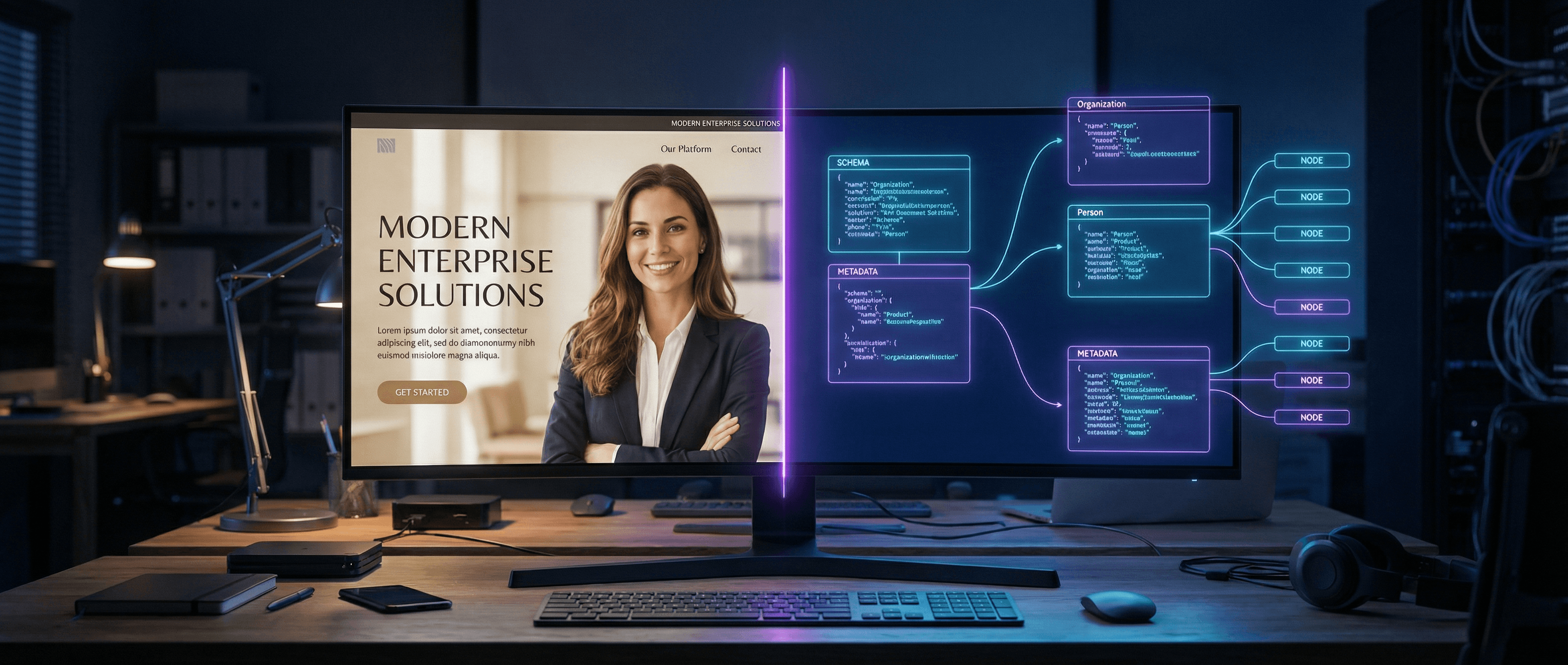
What the agent sees is your raw HTML, your metadata, your schema markup — or the lack of it. And based on what it finds (or doesn't find), it either recommends you or skips you entirely.
No click. No bounce. No analytics event. You never even knew the visit happened.
Two Audiences, One URL
Every page on your website now serves two fundamentally different consumers:
The Human Visitor
- Responds to visual design, brand feel, emotional triggers
- Navigates via menus, scrolls, clicks
- Makes decisions over minutes, hours, sometimes days
- Influenced by social proof, urgency, aesthetics
The AI Agent
- Parses structured data, metadata, and machine-readable content
- Navigates via schema, sitemaps, and semantic relationships
- Makes decisions in milliseconds
- Influenced by clarity, completeness, and verifiability of information
These two audiences want fundamentally different things from the same URL. And here's the uncomfortable truth: you've been building exclusively for one of them.
Traditional web strategy — SEO, UX, CRO — is entirely human-centric. It assumes the visitor has eyes, emotions, and a mouse cursor. That assumption is becoming increasingly incomplete.
The Recommendation Gap
Think about how purchase decisions are shifting.
A year ago, a potential customer might Google your product, click through three results, read some reviews, and make a call. You had multiple touchpoints to influence them.
Today, that same customer might ask an AI assistant: "Compare the top three options for [your category] and tell me which one to go with."
The agent does the research. The agent reads the websites. The agent makes the recommendation. The human sees a shortlist of one to three options — and picks from there.
If your website can't communicate clearly to that agent, you're not on the shortlist. Not because your product is worse. Because the agent couldn't understand you well enough to recommend you.
This is the recommendation gap: the distance between what your brand actually offers and what an AI agent can understand about what you offer.
The wider that gap, the more invisible you become — not to humans, but to the systems humans increasingly trust to make decisions for them.
What Agents Actually Need
So what does the invisible audience want? It's simpler than you'd think — and harder than most teams realize.
1. Structured Identity
Who are you? What do you do? Where do you operate? What categories do you compete in? Agents need this in machine-readable format — not buried in a paragraph on your About page.
JSON-LD schema is the baseline. But emerging standards like LLM-LD go further, providing AI-native structured data specifically designed for agent consumption.
2. Verifiable Claims
Agents are trained to evaluate credibility. "We're the best in the industry" means nothing. "Serving 2,400 clients across 14 industries since 2018" means everything. Specificity is trust.
3. Contextual Completeness
Can an agent understand your full offering from your website alone? Or does it need to piece together fragments from six different pages, two PDFs, and a press release?
Agents reward completeness. If your pricing, capabilities, differentiators, and use cases are clearly structured and accessible, you're easier to recommend.
4. Semantic Relationships
How do your products relate to each other? How does your brand fit within its category? Agents think in relationships, not pages. Internal linking, schema nesting, and category taxonomy all matter.
The Compounding Problem
Here's what makes this urgent: agent behavior compounds.
When an AI agent recommends your competitor three times this week, it's not just three lost leads. It's training data. It's reinforcement. The agent is learning that your competitor is a reliable recommendation — and you're not.
Over time, the agents that recommend your competitor will recommend them more confidently, more frequently, and in more contexts. Meanwhile, your brand fades further from the agent's consideration set.
This isn't a traffic decline you'll see in Google Analytics. It's an invisible erosion of market position that won't show up in any dashboard you currently monitor.
By the time you notice the impact — fewer inbound leads, lower conversion on branded searches, shrinking pipeline — the gap may already be significant.
What To Do About It
The good news: this is a solvable problem, and the brands that move now have a massive first-mover advantage.
Start with an audit. Can an AI agent understand your core offering from your website's structured data alone? Strip away the visuals, the copy, the design — what's left for a machine to read?
Implement machine-readable layers. JSON-LD schema is table stakes. Go further with AI-native standards like LLM-LD that give agents exactly what they need: structured identity, capabilities, differentiators, and context.
Monitor the invisible traffic. Tools are emerging to track AI agent visits — crawlers, parsers, and recommendation engines that hit your site without ever showing up in traditional analytics. If you're not monitoring this traffic, you're flying blind.
Think in recommendations, not rankings. SEO trained us to think about rankings. The new game is about recommendations. It's not "are we on page one?" It's "when an agent is asked about our category, are we in the answer?"
The Window Is Open
Most of your competitors haven't figured this out yet. They're still optimizing exclusively for human visitors, running the same SEO playbook they've run for a decade, wondering why their pipeline metrics are shifting in ways they can't explain.
That's your window.
The brands that make themselves legible to AI agents now — that speak both languages, human and machine — will own the recommendation layer for their category. The ones that don't will spend the next three years trying to catch up.
Your website has two audiences. It's time to start serving both of them.
Dominick Luna is Co-Founder of Capxel, the AI-native consumer intelligence company pioneering Agentic Search Optimization (ASO). Capxel helps brands become discoverable, legible, and recommendable to AI agents.

Related posts


Get ASO insights in your inbox.
Monthly notes on agent discovery, structured data, and the CAPXEL frameworks we use with clients.