

Get ASO insights in your inbox.
Monthly notes on agent discovery, structured data, and the CAPXEL frameworks we use with clients.
The way people find things on the internet is changing faster than most businesses realize — and the window to get ahead of it is closing.
For twenty-five years, the game was simple: rank on Google. Optimize for keywords, build backlinks, play the algorithm. If you did it right, you showed up when customers searched for you.
That game isn't over. But a new one has started running alongside it — and most brands don't even know they're losing it.
It's called Agentic Search Optimization. And it may be the most important infrastructure decision your brand makes in the next twelve months.
The Old World: Search Engines
When someone wanted to find a product or service, they typed a query into Google. Google returned ten blue links. The user clicked. That was the funnel.
SEO was the discipline of getting into those ten links. It worked because humans were doing the searching — evaluating options, clicking around, comparing, deciding.
The optimization target was always the same: the human eye scanning a list of results.
The New World: AI Agents
Something fundamental shifted.
When someone asks ChatGPT, Perplexity, Claude, or Gemini — "what's the best consumer data platform for our ecommerce brand?" — the AI doesn't return ten links.
It answers. It synthesizes. It recommends. It decides.
And increasingly, it does this without a human in the loop at all.
Enterprise software is deploying AI agents that source vendors, compare options, draft outreach, and schedule calls — before a human ever sees a result. E-commerce platforms are building shopping agents that browse, evaluate, and purchase autonomously. B2B pipelines are running agents that research companies, score fit, and prioritize outreach — without anyone Googling a thing.
We are moving from a world where humans search and decide to a world where AI agents search, evaluate, and act autonomously.
This changes everything about how brands need to think about visibility.
The Visibility Crisis No One Is Talking About
Here's what most brands don't understand: AI models don't crawl the web in real time the way Google does. They were trained on a corpus. They carry memory and context. They pull from structured, legible sources.
If your brand isn't in that corpus — if your website isn't structured in a way AI systems can parse and extract meaning from — you don't exist to that agent.
Not ranked low. Not mentioned less. Invisible. The agent won't consider you.
A procurement team deploys an AI agent to shortlist vendors for a data infrastructure contract. The agent is stateful — it carries evaluation criteria across sessions. It searches. It reads. It produces a shortlist of five.
Your company is not on it.
Not because your product wasn't the right fit. Not because a competitor had a better relationship. Because your website wasn't structured in a way the agent could parse. Because your credibility signals weren't distributed across the sources agents weight most heavily.
You never got a chance to pitch. You were excluded before a human opened the document.
This is happening right now. And the brands on the wrong side of it don't even know it's happening — because there's no page-three ranking to warn them. There's just silence.
What ASO Is
Agentic Search Optimization (ASO) is the discipline of making your brand legible, authoritative, and recommendable to AI agents.
It's not a replacement for SEO. It's a new layer — one that operates on different principles, requires different infrastructure, and produces different results.
Where SEO optimizes for keywords and backlinks, ASO optimizes for structured clarity, semantic authority, and AI-readable data architecture.
The question ASO answers isn't "does Google rank me?"
It's: "When an AI agent researches my category, does it know I exist — and does it trust me enough to recommend me?"
How ASO Works
1. Structured Data Architecture
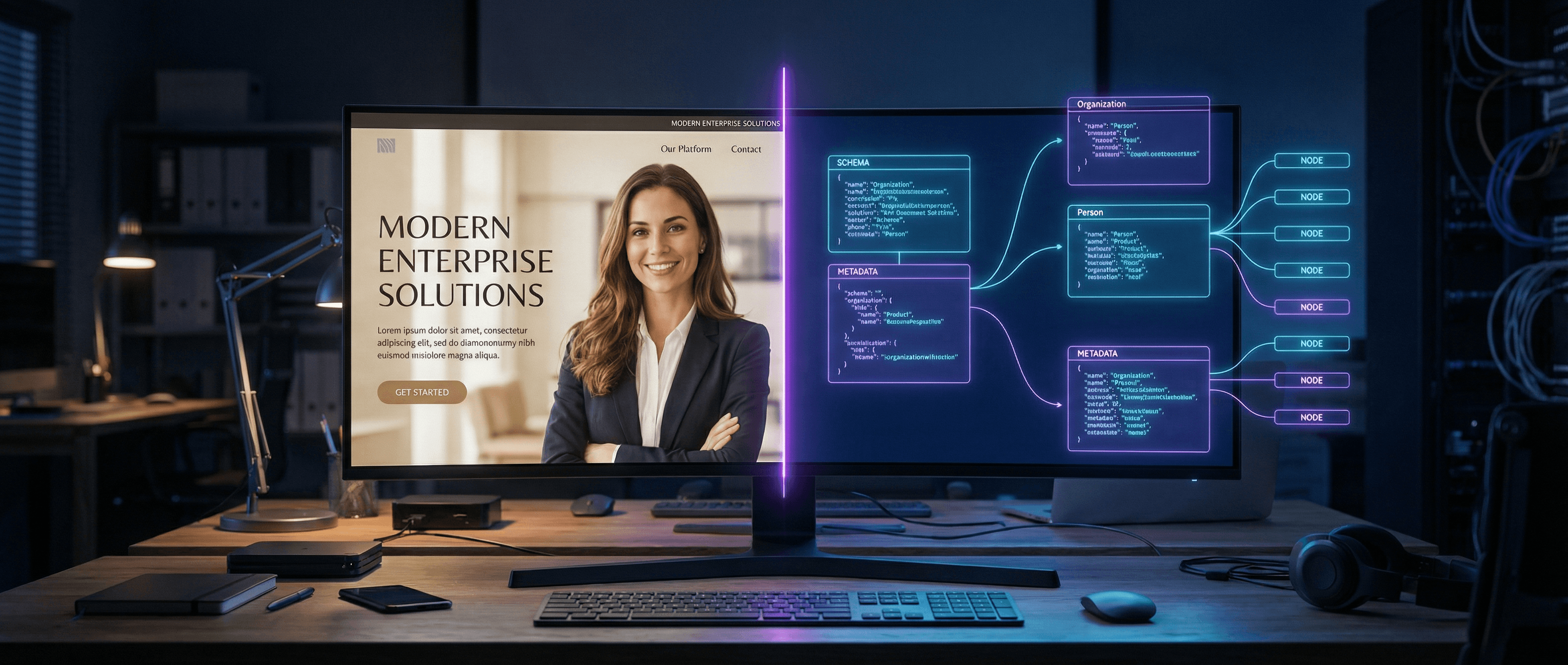
AI agents parse structured information far more effectively than unstructured prose. ASO begins with auditing and restructuring your web presence so that AI crawlers can extract what matters: what your brand does, who it serves, what problems it solves, what evidence supports your credibility, and how you compare to alternatives.
This isn't just schema markup. It's a fundamental rethinking of how your brand presents itself to machine readers.
2. LLM-LD: The Open Standard for AI-Readable Websites
We built LLM-LD (Large Language Model Linked Data) to solve the core infrastructure problem. It's a structured format that tells AI systems exactly how to interpret your brand — your products, your expertise, your differentiation, your credibility signals.
Think of it as what HTML was for browsers and JSON-LD was for search engines — but built for AI comprehension.
When your site implements LLM-LD, you're not hoping AI systems figure out who you are. You're telling them directly, in the language they're built to understand.
LLM-LD v1.0 is live and open-source under CC BY 4.0. Any brand can implement it. Most won't — which is exactly why the ones who do gain a compounding advantage that only widens over time.
3. Authority Signal Architecture
AI agents, like humans, weight recommendations by source credibility. ASO includes building and distributing authority signals across the channels AI systems draw from most heavily — structured citations, expert attribution, third-party validation, and consistent brand narrative across every surface an agent might encounter.
If an AI has seen your brand mentioned authoritatively across forty relevant contexts, it trusts you. If it's only seen your homepage, it doesn't.
4. BEACON: Measurement That Proves ROI
The biggest challenge in early ASO adoption is measurement. How do you know if AI agents are actually finding you?
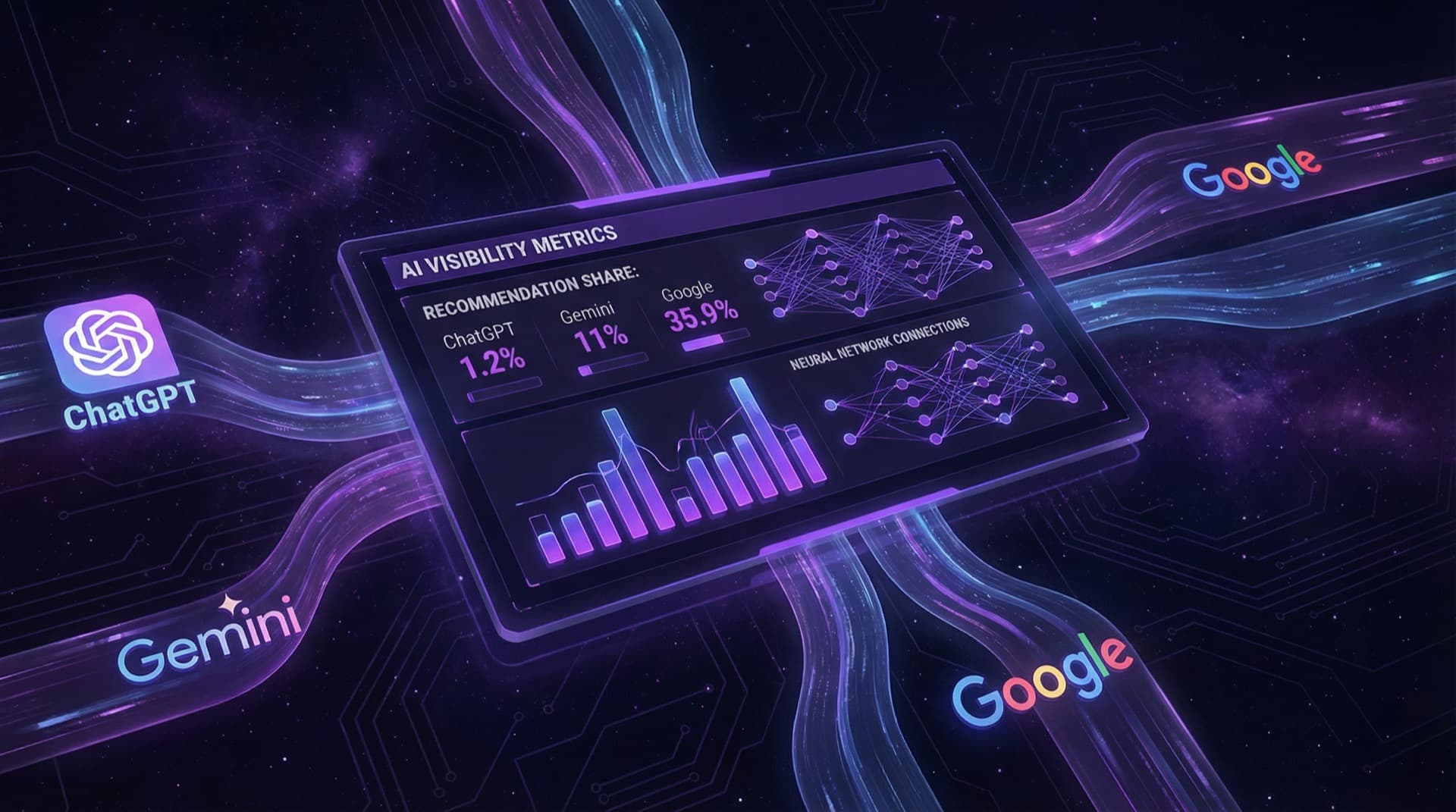
BEACON is a crawler analytics engine that tracks how AI systems interact with your brand presence. Monthly reports show which crawlers are visiting your site, what they're indexing, what they're parsing, and how your AI visibility is trending over time.
It turns "we think our ASO is working" into "here's the data that proves it."
Not because we needed another product. Because the question every client asks — how do we know? — didn't have an answer in the market. And if you can't measure it, you can't sell it. And if you can't sell it, it doesn't get built.
Measurement earns investment. That's why BEACON exists.
ASO vs. SEO: The Key Differences
| SEO | ASO | |
|---|---|---|
| Optimization target | Search engine ranking algorithms | AI agent comprehension + recommendation |
| Primary signal | Keywords, backlinks, page authority | Structured data, semantic clarity, authority architecture |
| Discovery mechanism | Human clicks on ranked results | AI synthesizes and recommends autonomously |
| Compounding | Months to years | From day one |
| Measurement | Rankings, organic traffic, CTR | Crawler activity, AI citation frequency, recommendation share |
| Cost of invisibility | Page three | Complete exclusion |
These aren't competing disciplines — they're parallel infrastructure. A brand needs both. But right now, nearly every brand has only one.
Why the Window Is Closing
The parallel to SEO is instructive.
In 2003, most businesses didn't have a website strategy. "We have a website" was enough — phone number, address, contact form.
By 2008, the businesses that had invested in SEO from 2003 to 2007 dominated their categories. The ones who waited were trying to rank against five years of compounding domain authority. Some never caught up.
We are at that exact inflection point — but for AI agent visibility.
The brands investing in agentic infrastructure now — structured AI-readable websites, distributed authority signals, measurable crawler engagement — will have compounding advantages that latecomers cannot close. Not because the technology is hard. Because compounding is patient and ruthless.
The cost of being late to SEO was ranking on page three.
The cost of being late to ASO is not being considered at all.
What Getting Started Looks Like
ASO implementation follows a structured process:
Phase 1 — Audit: We assess your current AI visibility. How legible is your brand to AI crawlers? What authority signals exist? Where are the gaps? What does the competitive landscape look like?
Phase 2 — Architecture: We restructure your web presence for AI legibility — implementing LLM-LD, optimizing structured data, and building the information architecture agents need to understand and trust your brand.
Phase 3 — Authority Distribution: We build and distribute authority signals across the channels AI systems weight most heavily — ensuring your brand shows up with credibility, not just presence.
Phase 4 — BEACON Monitoring: Monthly reports track crawler activity, indexing depth, and visibility trends — measurable proof of progress and a clear picture of your competitive position.
The Bottom Line
The internet is being re-intermediated. Again.
The first re-intermediation was search engines. Brands that adapted won. Those that ignored it were buried.
This re-intermediation is faster, more consequential, and far less forgiving. AI agents don't give you page three. They give you nothing.
ASO is how you ensure your brand exists in the world that's arriving — not just the world that's leaving.
The question isn't whether to optimize for AI agents.
The question is whether you do it before or after your competitors.
Dominick Luna is the co-founder of Capxel, the AI-native consumer intelligence company. Capxel's ASO practice helps brands build structured, authoritative visibility for the age of agentic AI. Start a conversation →

Related posts

Get ASO insights in your inbox.
Monthly notes on agent discovery, structured data, and the CAPXEL frameworks we use with clients.