

Get ASO insights in your inbox.
Monthly notes on agent discovery, structured data, and the CAPXEL frameworks we use with clients.
If you're a business owner or marketing leader, you've probably started hearing about GEO — Generative Engine Optimization. Maybe your agency mentioned it. Maybe you read about it on LinkedIn. Maybe you've even started investing in it.
Here's the problem: GEO solves about 20% of the actual challenge. And if you stop there, you'll spend money optimizing for a future that's already moved past you.
This isn't a criticism of GEO. It's an honest assessment of where it fits — and where it falls short — in the rapidly evolving AI search landscape. By the end of this article, you'll understand the difference between GEO, AEO, and ASO, why the distinction matters for your revenue, and what a complete AI search strategy actually looks like.
The Shift That Changes Everything
Let's start with the data, because the data is what makes this urgent.
AI Overviews now appear in 25% of Google searches. That's up from 13% just one year ago. One in four people searching on Google are getting an AI-generated answer before they see a single organic result.
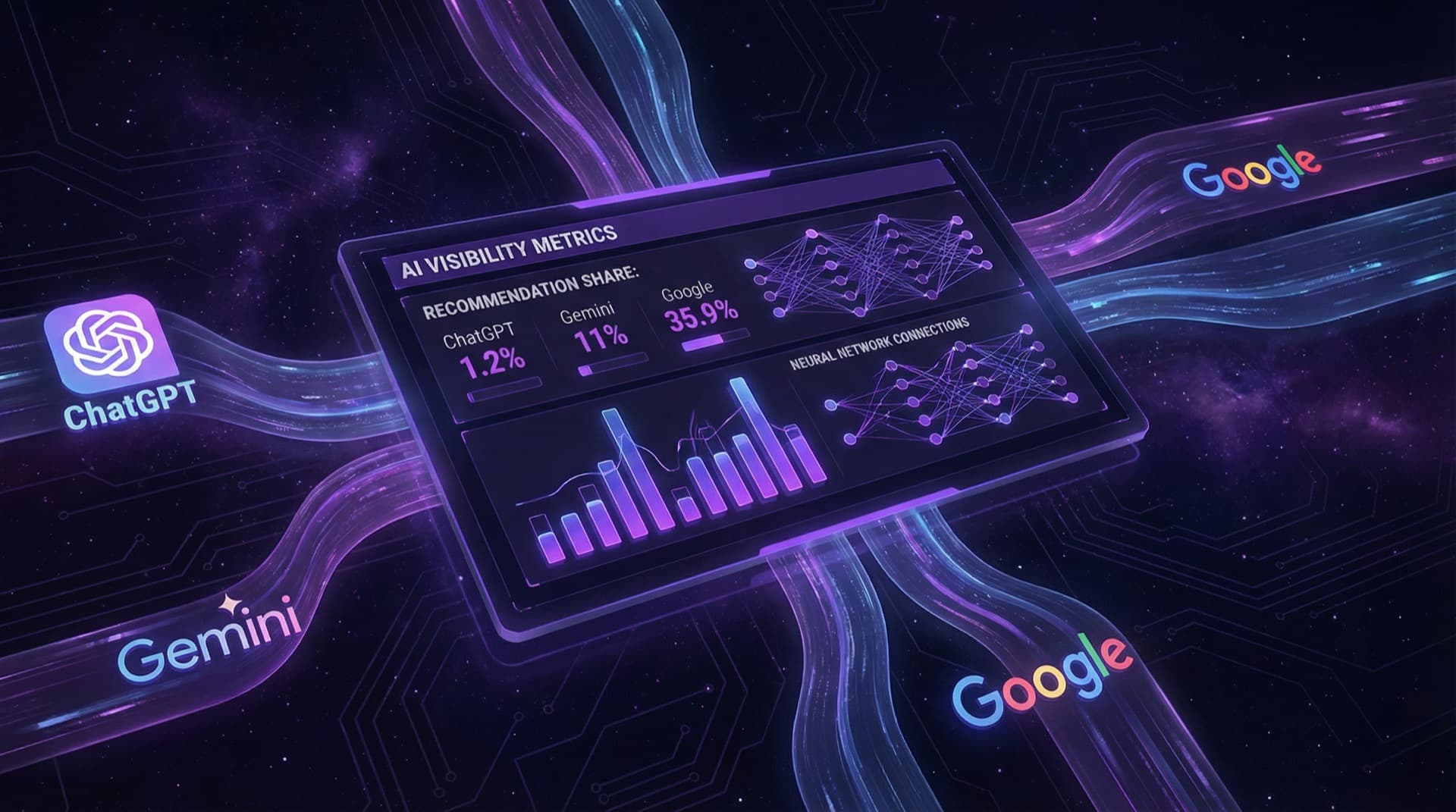
AI referral traffic grew 1,200% in twelve months. ChatGPT alone drives 87.4% of that traffic, according to Conductor's 2026 benchmarks.
Perplexity, Claude, Gemini, and dozens of other AI assistants are becoming mainstream consumer tools. When someone asks their AI "what's the best CRM for small businesses?" or "find me a medical spa in Tampa," the AI doesn't return a list of links. It gives a direct answer. One recommendation. Maybe two.
If your brand isn't part of that answer, you're not ranked lower. You simply don't exist for that consumer.
This is the most significant shift in how consumers discover businesses since Google itself launched. And most businesses are still optimizing for a world that's disappearing.
Understanding the Acronyms
The AI search optimization space is cluttered with terminology. Let's cut through it.
GEO — Generative Engine Optimization
What it does: Optimizes individual pieces of content to appear in AI-generated responses. Focuses on how you write blog posts, FAQs, and landing pages so that AI models are more likely to cite or reference them.
Typical tactics:
- Writing content in Q&A format that mirrors how AI models structure answers
- Including authoritative citations and statistics that AI models prefer
- Structuring paragraphs to be easily extractable by AI summarization
- Targeting long-tail, conversational queries
What it gets right: Content structure matters. AI models do prefer well-organized, authoritative, citation-rich content. If your blog posts are walls of marketing fluff, AI models will skip over them.
What it misses: GEO treats AI search as a content problem. It asks "how do I make this page show up in AI responses?" That's the wrong question. The right question is "how do I make AI agents understand my entire business?"
AEO — Answer Engine Optimization
What it does: Structures content specifically for featured snippets and direct-answer formats. Focuses on getting your content selected as THE answer to specific queries.
Typical tactics:
- Optimizing for question-based queries
- Using schema markup for FAQ pages
- Structuring content in concise, definitive answer formats
- Building topical authority through content clusters
What it gets right: Direct answers drive traffic. Position zero (the featured snippet) has been valuable for years, and AI Overviews amplify this dynamic.
What it misses: AEO is fundamentally an SEO extension. It's still page-level optimization. It doesn't address the systemic problem: AI agents don't evaluate your brand page by page. They build a holistic understanding of your entire business from every data point they can find.
ASO — Agentic Search Optimization
What it does: Builds a complete, machine-readable knowledge architecture that enables AI agents to understand, evaluate, and recommend your entire business. Not individual pages — the whole entity.
The approach:
- Deploying structured knowledge graphs that map your services, differentiators, credentials, and capabilities
- Creating machine-readable data layers (LLM-LD) designed specifically for AI agent consumption
- Building entity relationships that help AI agents understand how your business connects to categories, locations, and specialties
- Implementing AI-specific discovery endpoints (
.well-known/llm-ld.json) so agents can find and read your structured data - Monitoring which AI agents are visiting your infrastructure and what they're requesting
What makes it different: ASO doesn't optimize content. It builds infrastructure. The distinction is the same as the difference between writing a better email (GEO) and building a CRM system (ASO). One is a tactic. The other is a foundation.
Why the Distinction Matters for Your Business
This isn't academic. This directly impacts revenue.
Scenario 1: You Invest in GEO Only
You hire an agency to optimize your content for AI search. They rewrite your blog posts, add better citations, structure your FAQs. Your content quality improves. Maybe a few of your articles start appearing in AI-generated responses for specific long-tail queries.
The problem: When an AI agent is asked to recommend a business in your category — not answer a question your blog covers, but actually recommend YOUR COMPANY — it needs more than good blog posts. It needs to understand what you do, how you're different, who you serve, where you're located, what your credentials are, and why you should be trusted over alternatives.
That information exists on your website — scattered across your About page, your Services pages, your testimonials, your team bios. But it exists as marketing copy designed for humans. The AI agent has to extract facts from persuasion, parse bullet points written for emotional impact, and somehow build a coherent entity model from content that was never designed to be machine-readable.
Some AI agents will manage. Most won't bother. They'll recommend whoever gives them clean, structured data first.
Scenario 2: You Invest in ASO
You deploy a complete LLM-LD knowledge architecture. Every service, every differentiator, every credential, every location — structured in machine-readable format. An AI-specific subdomain (ai.yourdomain.com) serves as the definitive source of truth about your business for any AI agent that encounters it.
The result: When any AI agent — today or a year from now — needs to understand your business, it gets a complete, structured, trustworthy picture in milliseconds. Not by parsing your marketing copy. By reading your knowledge architecture.
Your blog posts still matter. Your content still matters. But they're built on top of infrastructure that ensures AI agents can recommend you, not just cite an article you wrote.
The Compound Effect
Here's what makes this a strategic decision, not just a tactical one:
AI agents learn and remember. When an AI model encounters your LLM-LD structured data, it doesn't just use it once. That structured information becomes part of the model's understanding of your business. Future queries benefit from the foundation you built today.
Companies deploying AI-readable infrastructure now are building compounding authority with AI agents. By the time their competitors realize what happened, the early movers will have months — potentially years — of established AI visibility that can't be replicated overnight.
GEO is a blog post that might get cited tomorrow. ASO is infrastructure that compounds over years.
The Real-World Gap
We've deployed ASO infrastructure across five industries. Here's what we consistently find:
Before ASO deployment:
- Zero AI agent recommendations for the business's core service category
- AI agents either can't find the business or provide incomplete/inaccurate information
- Website has strong Google rankings but zero AI search visibility
After ASO deployment:
- AI agents can accurately describe the business, its services, and its differentiators
- Business starts appearing in AI-generated recommendations for their category
- AI visibility becomes measurable and improvable through monthly intelligence reports
The gap between "strong Google presence" and "AI visibility" is massive. We haven't found a single client with traditional SEO who already had adequate AI-readable infrastructure. Not one.
What a Complete AI Search Strategy Looks Like
If you're a business owner reading this, here's the framework:
Layer 1 — Foundation (ASO): Deploy machine-readable knowledge architecture. This is the infrastructure layer. Without it, everything else is building on sand.
Layer 2 — Content (GEO/AEO): Optimize your content strategy for AI consumption. Better structure, authoritative citations, Q&A formats. This is the content layer. It works best when built on top of Layer 1.
Layer 3 — Monitoring (BEACON): Track which AI agents are visiting your infrastructure, what they're requesting, and how your AI visibility changes over time. This is the intelligence layer. It proves ROI and identifies opportunities.
Most agencies are selling Layer 2 as a complete solution. It's not. It's one-third of the solution.
The businesses that will dominate AI-driven discovery in 2026 and beyond are the ones investing in all three layers — with the foundation first.
The Standard Behind ASO
ASO is built on LLM-LD — an open standard for AI-readable websites.
Think of it this way: JSON-LD gave websites a standardized way to communicate with search engines. LLM-LD gives websites a standardized way to communicate with AI agents.
LLM-LD is published as an open standard under Creative Commons BY 4.0. It's free to use, free to build on. Over 100 sites are running it today, with ten agencies in the LLM Disco Network providing implementation services.
We authored the standard. We built the tooling. And we white-label the implementation so any agency can offer ASO to their clients under their own brand.
The standard is free. The expertise is what you're paying for.
What to Do Next
If you're a business owner:
- Test your AI visibility right now. Ask ChatGPT, Perplexity, or Claude to recommend a business in your category and location. Are you mentioned? Is the information accurate?
- Assess your AI-readable infrastructure. Does your website have structured data beyond basic schema markup? Do you have a
.well-known/llm-ld.jsonendpoint? Is your business information available in machine-readable format? - Talk to your agency. Ask them about their AI search strategy. If they only mention GEO or content optimization, they're selling you Layer 2 without Layer 1.
If you're a marketing agency:
- Understand the shift. AI search isn't a future threat. 25% of Google searches already show AI Overviews. Your clients need this now.
- Offer the complete solution. Content optimization alone won't cut it. Your clients need infrastructure.
- Talk to us about white-labeling. We provide the full ASO pipeline — DG1 data extraction, FG1 file generation, server deployment, BEACON monitoring — under your brand. Clean margins, recurring revenue, competitive differentiation.
The window is open. It won't stay open forever.
Contact us at dominick@capxel.com or visit capxel.com/aso.
Capxel is an AI-native consumer intelligence company and the creator of Agentic Search Optimization (ASO) and the LLM-LD open standard. We don't compete with agencies — we power them.

Related posts


Get ASO insights in your inbox.
Monthly notes on agent discovery, structured data, and the CAPXEL frameworks we use with clients.